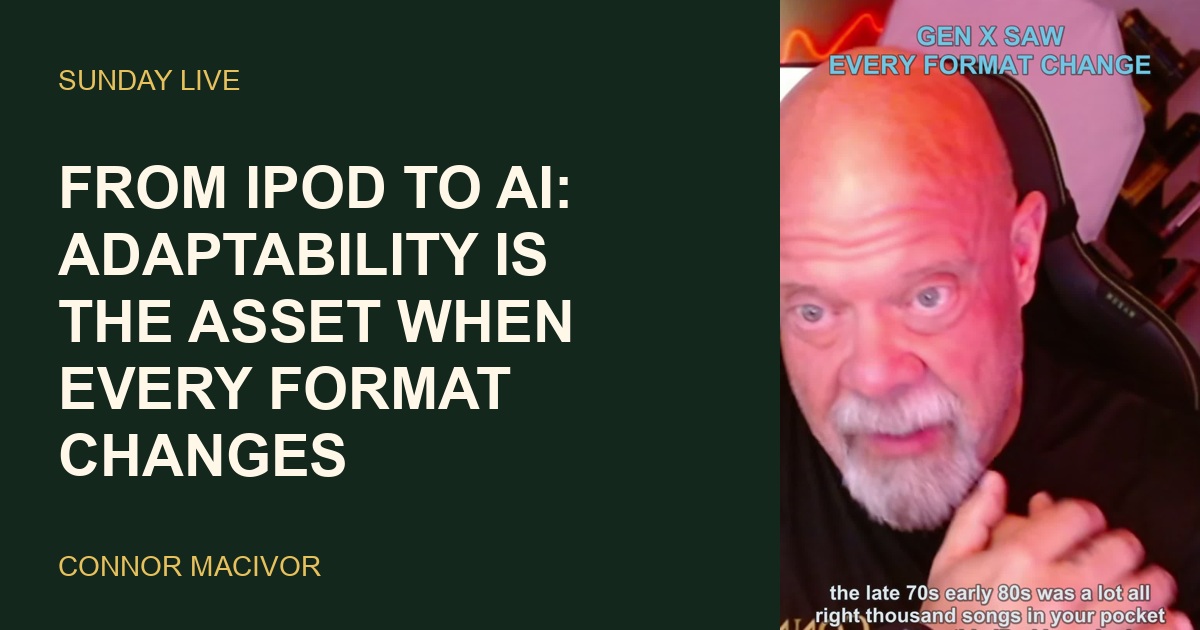
The iPod turns 25 this month. The little white box is gone, but the habit it forced on a whole generation is still the most valuable thing most of us own: when the format changes, you learn the new one and keep moving.
The iPod Turns 25 This Month
Apple launched the iPod on October 23, 2001. The pitch was four words and a number: 1,000 songs in your pocket. That is the whole idea, and it was enough. If you were around then, you remember how strange it sounded. A thousand songs used to mean a shelf, a shoebox of tapes and a binder of CDs that slid around the back seat.
I brought it up on the Sunday LIVE on October 4 because the anniversary dates a lot of us. I apologized on air for that, and I meant it. Twenty-five years is long enough for a gadget to be invented, take over, and disappear. Apple ended iPod sales in May 2022, when the last model was discontinued. So the device that changed everything did not even make it to its own 25th birthday.
That is the first lesson, and it is the one worth sitting with. The iPod was not the point. Nobody who learned to load one in 2002 is still using that skill on that device today.
What they kept was something underneath it: the willingness to rip their collection, learn a sync screen, rebuild a playlist and trust a new way of carrying music. That willingness is portable. The device was not.
How the Podcast Got Its Name
Here is a piece of trivia most people under 30 have never heard. The word "podcast" is iPod plus broadcast. It showed up in print in The Guardian in February 2004, in a piece by Ben Hammersley. At the time, people were figuring out how to put spoken audio shows on the same players they used for music, and the language needed a word for it. The one that stuck borrowed Apple's product name.
Think about how odd that outcome is. The iPod is gone from the shelves. The word it lent out is everywhere. Shows that never touch an Apple device are still called podcasts, and plenty of people listening to them have no idea the name came from a music player. The format outlived the gadget, and the name outlived both.
I said on the LIVE that I do not think a lot of people remember where the word came from. That matters for one reason. When you are standing in the middle of a format change, you cannot see which part will last. In 2004 most people would have bet on the device.
The device lost. The habit of carrying your own shows, on your own schedule, won. Keep that in mind the next time somebody tells you which AI tool will still be here in five years. Nobody knows. Bet on the habit.
Who Decided What You Heard
Before the iPod, the radio station picked the songs. You could call in a request and hope, or you could sit by the stereo with a blank tape and your finger on the record button, waiting for the DJ to stop talking over the intro. A program director you never met decided what an entire city heard on the drive home.
"Before, radio station decided what you heard. Now you carried your own station in your pocket." (Connor, Sunday LIVE, October 4, 2026)
That is the shift that mattered most, more than the battery or the click wheel. Control of the airwaves moved from a building with a tower to the person with the earbuds. Then podcasting pushed it one step further. You did not just pick what to hear. You could be what other people heard, without asking a station manager for a slot.
Look at what you are reading right now. It comes from a show I broadcast live from my home office. No tower. No program director.
Nobody approving the topic list before I talk about the market or AI on a Sunday evening. Twenty-five years ago that would have taken a studio and somebody's permission. Today it takes a camera, a microphone and the nerve to push the button. Gatekeepers did not vanish, but the number of doors you have to knock on before you can reach people dropped to almost zero. If you run a small business and you are still waiting for a newspaper or a radio host to tell your story, you are waiting on a station that no longer owns the dial.
My First Player Was a Big Cassette Box
I asked the people watching the LIVE to drop their first music player in the comments. The answers came in fast: Walkman, Discman. Mine came before both.
My first was a large cassette player. The Walkman came after that, and I remember those things feeling expensive. Twenty bucks was a lot of money in the late 70s and early 80s, especially for a kid.
Then there was maintenance, which nobody under 35 can picture. Tapes got loose. If the tape was not tight when you put it in, some car cassette players would jumble it.
So you rewound them by hand. You stuck a pencil in the spool hole and spun it, or you used your index finger if you did not have a pencil handy. Every Gen Xer reading this just felt that motion in their wrist.
What did that teach? Something real. You learned that the machine had a way it wanted to be treated, and that a minute of care up front saved you a ruined tape later.
You learned to look at the mechanism instead of blaming the music. That is the same instinct you need with AI: understand what the tool needs from you before it chews up your work. A sloppy prompt is a loose tape. The machine will still play it, right up until it does not.
The Day the Trans Am Ate the Tape
Picture it. The car cassette player in a Pontiac Trans Am, everybody's dream car back in the day. You have your best song in the world queued up, maybe the soundtrack from Grease.
The volume is up, the windows are down, and then the deck eats the tape. Ribbon everywhere. Song over. Day ruined.
I laughed about it on the LIVE, but there is a working lesson buried in that memory. Every format fails eventually, and usually at the worst possible moment. The people who got hurt least were the ones who had a second copy, who knew how to splice a tape, or who simply did not build their whole drive around one cassette. Back then a backup meant dubbing a copy on a double-deck stereo. Today it means something else, but the principle has not moved an inch.
If your business runs on one AI tool, one login, one subscription and one person who knows how it works, you are driving that Trans Am with one tape. When the service changes its price, changes its rules or goes down on a Monday morning, the ribbon is on the floor. I wrote a whole piece about this: what happens if the tool you rely on disappears.
You can read it here: keep the skill under the AI. The short version is simple. Use the tool, but keep enough of the underlying skill that a broken deck does not stop the car.
Burning, Ripping, Streaming: What Carried Over Each Time
"Rewinding tapes with a pencil, burning CDs, ripping them and then streaming them. Remember that format change?" (Connor, Sunday LIVE)
Every one of those changes felt like the end of the world to somebody. Each time, the gadget died and the skill underneath got carried forward into the next one. Here is what actually transferred, format by format.
- Cassettes: care and patience with the mechanism. You learned that a minute of prep beats a ruined tape.
- Burning CDs: curation. You had a little over an hour of space, so you learned to choose and to put the order in on purpose.
- Ripping your collection: organization. Song names, artist tags and folders taught a whole generation to manage files.
- The iPod: trust in a new way of carrying something you valued, and the habit of syncing and backing it up.
- Streaming: letting go of ownership and choosing on purpose instead of letting the feed choose for you.
- AI: all of the above at once, plus judgment, because the tool now produces work instead of only playing it.
Notice that nothing on that list is a button or a menu. Buttons and menus expire. Care, curation, organization, trust and choice do not.
That is why someone who mastered mixtapes in 1985 picked up playlists in 2005 without a class. The specific steps were new. The thinking was not.
So when you feel behind on AI, run that list on yourself. You probably already own most of the skills it needs. You have been learning new formats your whole life. You just have not been giving yourself credit for it.
Gen X Lived Through Every Format Change
"Gen X lived through every format change. Thank you very much. I think we survived." (Connor, Sunday LIVE)
I was born in 1969. My generation went from cassette tapes to the cloud. Records, tapes in the car, CDs, MP3s on the computer, the iPod in the pocket, streaming on the phone. Count them up and most of us switched how we carried our music more times than we can easily list.
That history is not a brag. It is evidence. If you are a Gen Xer or a boomer who feels like AI is moving too fast, look at your own track record. You have already adapted to more format changes than any generation before you.
You did not do it because you were a tech person. You did it because the old format stopped working and you wanted the music. That same motive works now. You do not have to love the technology. You have to want what it gets you.
"That adaptability is the asset now." (Connor, Sunday LIVE)
I mean that in a practical sense. Your experience is an asset. Your relationships are an asset.
Your judgment, built over decades of watching what works and what does not, is an asset. But the thing that lets you keep cashing in on all of them while the tools change is adaptability. Without it, the rest slowly loses value, because the world stops meeting you where you are.
Why AI Is a Bigger Format Change Than Any of Them
Every format change before this one changed playback. The song stayed the song. A tape, a CD and a stream of the same track all deliver the same performance. You changed how you carried it and how you pressed play. The work itself, the music, did not change.
AI is different, and I said so on the LIVE: it is a little bit bigger of a format change. It does not just change how you carry the work. It changes the work.
It drafts the email, answers the customer, summarizes the contract, writes the description, builds the slide. For a small business owner, that is not a new player. That is a new employee who never sleeps and is sometimes confidently wrong.
"AI, there is no way to tell anymore, and that's only going to get better." (Connor, Sunday LIVE)
The second difference is the one that keeps me up. With every old format, you knew what you were holding. A tape was a tape. Now you can no longer tell, by looking or listening, whether a voice or a face is real.
In 2024 the engineering firm Arup confirmed that an employee in Hong Kong sent about US$25 million after a video conference in which the CFO and other colleagues were deepfakes. The worker believed the people on the call were real. My own view is that before long you will be talking to customer service that tells you it is a person when it is not. That is my prediction, not a measured fact, but you should plan as if it is coming.
That is why adapting to AI is not only about learning to use it. It is also about learning to defend against it. I laid out the simplest defense I know, a family and business safe phrase, here: why a family safe phrase belongs in your AI era plan.
From 40 Words a Minute to 166
Here is my own format change, with numbers. In high school, our football coach told all of the players to take typing. So a bunch of us took it.
I ended up with two years of typing class. On my best day I topped out somewhere around 40, 50, maybe 60 words a minute. I have no idea what my error rate was. For decades that was how I got words out of my head and into a machine.
"If you're my age, you probably started typing, but now the voice is getting good." (Connor, Tuesday LIVE, October 6, 2026)
Now I talk to my AI instead of typing to it. On the Tuesday LIVE I pulled up the dictation app I use and read the numbers off it on camera: about 575,000 words dictated, at 166 words per minute. Against my old typing speed, that is roughly three to four times faster. I joked on air that a lot of those words are profanity.
Why does this matter to you? Because I am 57. I learned to type in a class a football coach pushed us into. I did not grow up talking to computers.
And I got faster by switching formats, not slower. The typing class was not wasted, either. It taught me to think in sentences and to put words in order on purpose, and that is exactly what makes voice input work. The format changed. The skill underneath carried over again.
If you want to try this, start small. Pick one task you already type every day, like a quick reply or a note to yourself, and say it instead for one week. Read it back before you send it. Fix what the app got wrong. By the end of the week you will know whether it fits you, and you will have learned it on real work instead of a tutorial.
What "Adaptability Is the Asset" Looks Like on a Tuesday
The phrase sounds nice on a poster. It only pays if it turns into something you do on a normal weekday. Here is what that looks like for someone who feels behind and does not have spare hours to study.
- Pick one annoying task, not ten. The weekly email you dread, the listing write-up, the meeting notes. Use AI on that one job until it is easy.
- Set a 30-minute weekly appointment with the new format. Same day, same time. Treat it like a client call you cannot skip.
- Change the input before you change the tool. Talking instead of typing gave me more speed than any new app did.
- Read every output before anyone else does. The tool writes the draft. You own what goes out the door.
- Write down what worked. One line in a notebook. In three months you will have your own manual instead of a stranger's.
None of that needs a course or a new subscription. It needs a calendar slot and the same stubbornness you used to fix a loose tape with a pencil. If you are not sure which task to start with, I wrote a separate walkthrough on picking the right job for AI before you spend money on it: find a useful problem first.
One more thing about pace. You do not need to keep up with every release. Nobody does, including the people who write about it full time. You need to keep up with your own one task, then add a second one when the first feels boring. Boring is the signal that the new format has become yours.
Do Not Wait for the Format War to End
A lot of smart people are sitting out AI because they want to see who wins. They figure they will learn it once things settle down. That sounds sensible.
It is a trap. Formats do not settle. The iPod looked like the final answer for music and it was gone in about two decades. Every format I have used has been replaced, and the ones replacing them will be replaced too.
The person who waits for the dust to clear does not get a calmer version of the change. They get the whole backlog at once, plus the feeling of being the last one in the room to figure it out. The person who keeps learning a little at a time barely notices the next switch, because switching has become routine for them. That is the real advantage Gen X earned. Not knowledge of any one device, but comfort with the next one.
There is a fairness piece to this too. When some people keep learning and others wait, the gap between them grows quietly, and it shows up in jobs, prices and who gets served first. I broke that down in plain terms here: the AI access gap, explained simply.
And if you are younger, reading this and smiling at the pencil-in-the-cassette story, this applies to you even more. You will live through more format changes than I have. The phone in your hand will look like a cassette deck to somebody one day. The tools you are fluent in now are not the asset. The willingness to drop them and learn the next thing is.
What You Keep When the Format Changes
Adapting does not mean throwing everything out. Every time the music format changed, the smart move was to carry the collection forward. You did not toss your favorite albums because CDs arrived.
You moved them. AI works the same way. Three things should come with you into every new format, untouched.
Your judgment. The tool can produce a hundred drafts. It cannot tell you which one is right for the client sitting across from you, the deal you are in or the reputation you have spent years building. Decades of seeing what goes wrong are exactly what the machine does not have. Keep the final call with a person, and make it you.
Your relationships. When customer service starts sounding more human than ever, the people who can still reach a real person they trust will stand out. A phone number a client knows you will answer is worth more in an AI world, not less. Do not let a chatbot stand between you and the people who built your business.
Your voice. AI writes in a smooth average. If you let it write everything, you start sounding like everybody else using the same tool. Your stories, your phrases, the way you explain things to a neighbor, that is what people remember and come back for. Use AI to get the draft moving, then put yourself back in it. I wrote about how to keep your writing sounding like you here: AI writing still needs your voice and your judgment.
Those three are the album collection. The format is just the player. Change players as often as you need to. Never leave the collection behind.
Where to Go Next
If this one landed, start with Seeing Is No Longer Believing. It shows you how to set up a safe phrase with your family and team before a fake call ever reaches them.
Next, read Keep the Skill Under the AI. It covers how to use the tool without losing the ability to work the day it disappears.
Not sure where your weekly practice should start? Before Building an AI Business, Find a Useful Problem walks you through picking the right first task.
The LIVEs these stories come from are on The Daily Download show hub. And if you want to talk through one specific AI workflow for your business, book time with me and bring the task you dread most.