If AI Is That Smart, Why Should the Transition Hurt?
November 3, 2026 // Daily Download // Connor MacIvor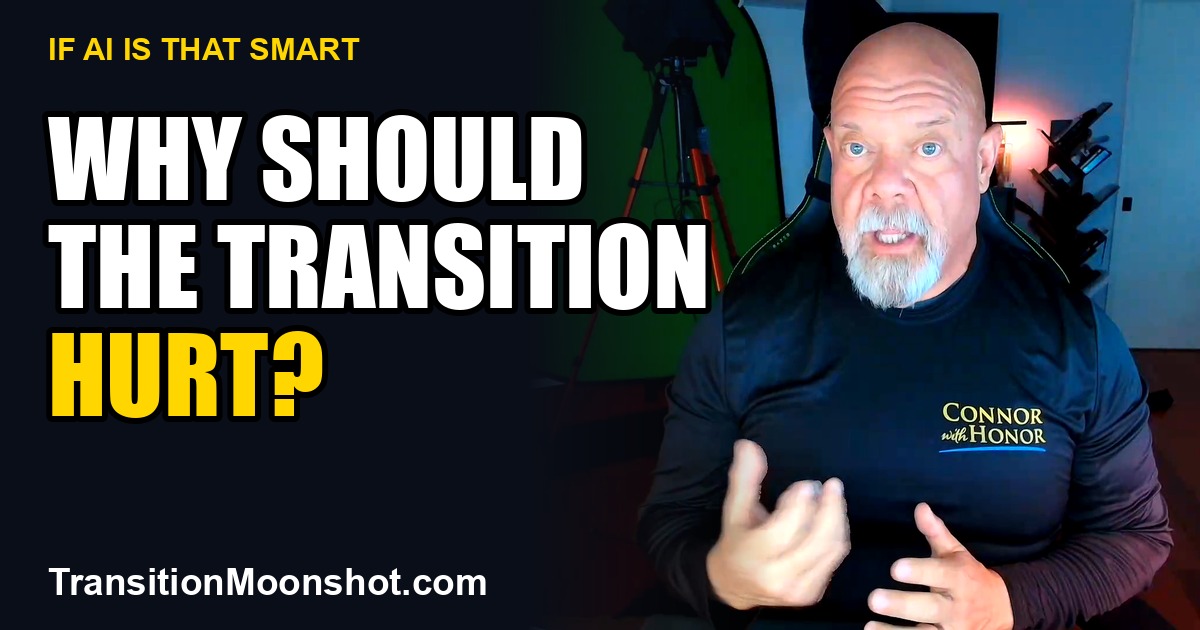
The Machine
Here's what keeps bugging me.
The people building artificial intelligence say it's going to be smarter than all of us. Cure diseases. Solve math nobody could solve. Run the power grid. Some of them say it's bigger than the Industrial Revolution.
If it's really that smart, then getting through the change it causes should be the easy part. Nobody in the bottom class, the middle class or the upper middle class should have to go through pain, strife or danger while this thing comes into its own. We should be fine. We should be better than fine.
So why does almost every conversation about AI skip the part in between? The part where real people lose real paychecks while the future gets built?
I'm Connor MacIvor. I spent 20 years with the LAPD, and I build businesses with AI every single day. I'm not against it. I'm against leaving people on the wrong side of the line.
Every machine worked. The people in the middle paid.
Go back through history and you see the same movie over and over.
The printing press worked. It also put ideas in people's hands that the powers that be didn't want printed, and a lot of people suffered while the world sorted that out.
The power loom worked. According to period wage records, in 1792 a hand weaver in Lancashire, England could make about 6 shillings a day. By 1826, the same skill paid less than 6 shillings a week. Same trade. Same hands. In the town of Bolton that year, roughly 1,500 of its 6,000 hand weavers had no work at all, and another 1,500 were on short time. Nobody fired them. A machine showed up that did the work cheaper, and the money went somewhere else.
The railways worked. In 1846, at the peak of what history calls Railway Mania, Parliament approved 263 new railway companies in a single year. Small investors put down deposits on shares, then got hit with "calls" for the rest of the money when the bubble turned. The so-called Railway King, George Hudson, paid dividends out of new capital instead of earnings, and was exposed in 1849. About a third of those approved lines were never built.
Britain still got its railroads. The technology won. The small investor with the deposit did not.
The 50-year pause nobody planned for
Here's the number I want you to remember. 50.
Economic historian Robert Allen went back through the numbers of the Industrial Revolution. From 1780 to 1840, output per worker in Britain rose 46 percent. Real wages for the people doing the work rose 12 percent. The machines got more productive. The owners did very well. The workers barely moved.
By Allen's account, wages didn't really start catching up until somewhere between 1830 and 1860. Call it about 50 years, two generations, of the gains going somewhere else. Economists named it Engels' Pause.
A boy who went into the mill could die before his pay ever caught up to what the machines produced.
The old mercy was a short life
This is the part I keep turning over.
Every one of those past transitions had a terrible kind of mercy built in. Lifespans were short. The people who had to live through the worst of it, well, they were dead in a generation or two. Not because of the loom. Just because of normal life. Everybody forgot. Everybody adjusted.
That mercy may be going away.
Tech money is pouring into living longer. Altos Labs launched with about $3 billion. NewLimit, a longevity company co-founded by Coinbase's CEO, raised $435 million this year. If AI really does crack aging, you don't get a hard stretch that ends with a generation. You get people living a very long time on the wrong side of a 50-year pause.
Let me keep this on the ground, because the facts matter. Right now there is no human evidence that AI extends lifespan. None. The closest real thing is a drug called rentosertib from Insilico Medicine, discovered with generative AI, which is now in a Phase 3 trial for a lung disease called idiopathic pulmonary fibrosis, with about 320 patients. That's a big deal. It's also one disease, it's not an aging pill, and approval is years out.
So we have time. That's the good news. Time is exactly when you build the bridge, not after the river floods.
Where we are right now
US employers announced 573,195 job cuts through September of this year, according to Challenger, Gray and Christmas. Separately, Challenger counted 120,136 of those cuts through September where the company cited AI as the reason, more than any other reason this year. But "cited" is the key word. That's the stated reason in the announcement.
New York added a box to its layoff notices where a company can say technology or automation caused the cuts. In the first year, more than 160 companies filed notices. Zero checked the box. The announcements and the legal forms don't line up, and nobody can say for sure why.
Stanford's Digital Economy Lab looked at workers aged 22 to 25 in the jobs most exposed to AI. Their employment is running about 19 percent below where it would have been. The researchers say it shows up mostly as companies not hiring, not as layoffs, and they don't claim AI caused it. The door isn't slamming. It's just not opening. And the New York Fed has said remote work explains about two thirds of the rise in young graduate unemployment, not AI.
The builders know. They wrote the plan.
Here's what gets me. The people at the top aren't blind to this.
In June, Anthropic, the company that makes Claude, published an economic policy framework that maps out what to do at about 5 percent unemployment, about 10 percent, and at levels nobody has seen before. Wage insurance is on the list. They put about $200 million into a research fund on AI's economic effects. OpenAI published its own proposals in April, including a public wealth fund and benefits that travel with the worker.
I give them credit for saying it out loud. But a framework and a research fund are not a bridge. They're a plan for a bridge. Neither plan pays a displaced worker to get across today.
Lose 90 percent. Whose pain is greater?
Think about it like this.
Somebody has $100 million and loses 90 percent of it. They still have $10 million. Somebody else has $1,000 and loses 90 percent. Now they have $100.
$10 million buys a lot more bread than $100. Same percentage. I can't tell you whose pain is greater, but I know who has less cushion.
When people say the transition "might be a little rough," that's the math they're skipping.
What if we just kept paying the person?
Here's the rule I floated on the show, and I'd like you to poke holes in it.
If a company replaces an employee with AI, the company keeps paying that employee through the transition. AI can do three, four, five times the work. It works 24 hours a day, 7 days a week, 365 days a year. It doesn't take time off. It doesn't get sick.
Let me show you the conservative math. Assume AI is only as good as a person at the job. Not better. A full-time person works about 1,880 hours a year after holidays, vacation and sick days. An AI seat can run 8,760 hours. That's about 4.66 times the hours. Knock it down for real-world uptime and somebody supervising it, and I think there may still be room in that surplus to carry the old worker across. That's my math, and I'd like to see a company run its own.
There's a selfish reason for business owners to like this too. The labor is what buys your stuff. If nobody has a paycheck, nobody is buying what you sell.
What I put up so we can talk about this
That's why I put up TransitionMoonshot.com. People are building moonshots to solve lots of other problems. Why not build one, with AI and a lot of smart humans, to get us all through this hump?
It lays out 4 pieces:
- The lease. When an apartment building sells, tenants with a lease don't get thrown out. When a company brings in AI to do a job, the person in that job comes with the deal for a while, paid through the transition with first shot at the new roles.
- The productivity dividend. A small share of each AI seat's savings goes into an account that follows the worker, not the employer.
- The builder path. People who get displaced get the same AI tools the big companies use, so they can build their own thing.
- The ground floor prize. A public prize for whoever moves the most displaced workers into equal or better income within 24 months.
It's free. No donations accepted. Your email is never sold. There's a pledge for people and a pledge for business owners.
While we figure it out, protect your family
One more thing from the show, because it can't wait for policy.
The people using AI to rip folks off are already here. Cloned voices. Fake video calls from a "grandchild" begging for bail money right now.
Sit down with the people you love, in person, away from phones and smart speakers, and agree on a phrase nobody else could guess. If a call for money doesn't start with that phrase, it doesn't move forward. No exceptions, no matter how upset the voice sounds. I wrote the full playbook here: make a family passphrase.
The machine was never the question
AI is a hammer. A hammer works for whoever's holding it. We have the technology of gods and, too often, the morals of toddlers.
Every machine in history worked. The question was never the machine. The question was always who got carried across, and who got told to hold on.
If superintelligence is as smart as its builders say, the transition is not a law of nature. It's an engineering problem. And the smartest engineer ever built should not need 50 years to solve it.
Take the pledge at TransitionMoonshot.com. If you want to use AI in your business without leaving your people behind, call or text the AI line at (661) 476-2217. And tell me where I'm wrong in the comments on the video. Let's do this human to human.
More on this: The AI utopia has a rough middle and Who pays for the AI boom?
TransitionMoonshot.com: a free plan to carry people across the AI transition. No donations accepted.
The Daily Download In Your Inbox
Weekday takes on AI, real estate, and reading the world like someone who used to work it. No spam. Unsubscribe anytime.
Connor T. MacIvor · CalDRE #01238257 · Sync Brokerage, Inc. · DRE #02031490