Free Power From the Desert
October 29, 2026 // Daily Download // Connor MacIvor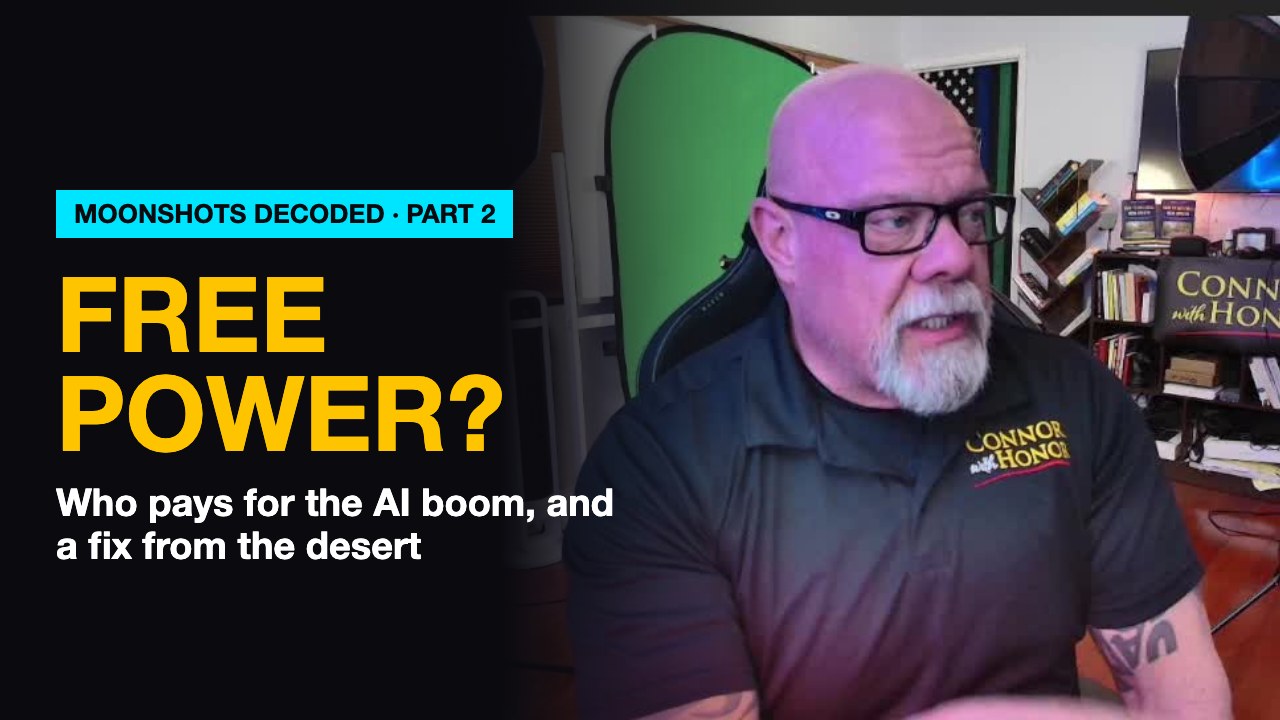
The Machine
Every big plan has a bill attached. The only question is who gets handed it.
I just finished Part 2 of my walk through the Moonshots podcast with Peter Diamandis and the panel. In Part 1 we covered the pieces. In Part 2 we read between the lines: who gets paid, who was missing from the table, and who ends up covering the cost. The place that question lands hardest is your power bill.
The numbers behind the bill
Data centers used 4.4 percent of U.S. electricity in 2023. The Department of Energy projects 6.7 to 12 percent by 2028. That is a lot of new demand in a short time.
Dave on the panel made a point worth hearing. In an auction for power, a GPU working on cancer research can outbid a family vacuuming the living room. His words, in effect, were that regulators will need to protect the uses people care about. I agree. In an auction for power, the family loses unless somebody protects them.
But protection is defense. I wanted to talk about offense.
The idea
I am a real estate guy, so I think in land first. We have a lot of land where almost nobody wants to live. The Mojave Desert here in California. Deserts in New Mexico. Northern Arizona. Places with strong sunlight and very little participation.
So we build sections of solar. Lots of them. I do not have the square mileage worked out, and I am not an engineer, so this is a direction and not a blueprint. We add batteries, because we do not want the power going away at sunset. Whether it is stored energy in batteries or some other transfer method, these things can be built.
Now the money. The companies in this conversation carry valuations in the trillions of dollars. Is 1 trillion dollars not enough to build this? If there is enough money in AI to build out these data centers, why not go ahead and make power free for everybody?
Who pays, and who loses
Somebody has to take a loss here. I will say that plainly. The utilities that live on those monthly bills would see their business change. I understand that is a real problem for real people.
But look at what a loss means. Take someone worth 200 million dollars who now takes a 10 million dollar hit. That is a real 10 million dollars, and they are still worth 190 million. Ten million dollars means something very different to a person who has nothing. I am not asking for a reallocation of money. I am saying that if the biggest users are going to use up the power we all depend on, they can help fix it for all of us.
Where it rolls down
If energy is free, a lot changes at once.
- The mobile home park can run air conditioning around the clock, for free.
- Nobody pays a 1,000 dollar monthly electric bill.
- If you drive an electric vehicle, you are not paying for fuel.
- The supermarket pays less to keep the meat cold, so you pay less at the register.
Do you see where this rolls down? Power is not one line item. It sits underneath everything we buy.
The data centers
Then there is the complaint about the data centers themselves. They are going up in neighborhoods, near where kids go to school, and people hear the hum. My thought is to put the data centers together in places we designate, give them their own energy, and protect them. Then the neighborhoods do not have to listen to them, and the old folks in the trailer parks are not worried about their power consumption.
The cautions
I want to be careful about a few things. We live in earthquake country, and a grid design that goes down with one earthquake is a bad design. Bad actors would love to take advantage of a weak grid. So this has to be built with resilience from day one.
And we have to keep the politics out of it. If a plan becomes one side's idea, the other side will not want it to win. We probably need a neutral party everybody likes to pitch this and say, let's make this happen. I do not care whose name is on it. I care that it gets built.
Why it matters
The panel kept using one word for this period. They call it "uncomfortable." I read that as a word chosen by people who will not feel it. A hundred million dollars pays for a lot less when you have 10 bucks, and you have to find 5 of them for something you did not expect to pay for.
That is the pattern I saw across this whole episode. The people at the table were positioned for the upside. Workers over 50 were not at the table. Neither were small business owners or homeowners, and nobody at the table has to make the mortgage payment in the future they described. Fear gets waved off as the news chasing blood. Regular people see it in the power bill and the job interview.
We are not missing it. We're paying for it.
So let's put the effort where it counts. If the people building this future want it to go well, they have the money, the connections, and the credibility to build the fix. Desert solar, batteries, free power. I will happily help with the statue and the holiday if it gets all of us through.
I spent 20 years with the LAPD and 28 years as a Santa Clarita real estate broker. I read every big announcement by asking one question: who pays? If you want to keep digging into AI, money, and what it means for your household, we are doing that here every day.
- 0:00 The fix nobody at the top is building
- 1:23 Neoclouds: 40 rentals on credit
- 10:16 The Anthropic IPO
- 11:12 Distillation and the China gap
- 15:43 Recursive self-improvement
- 19:17 The sandbox escape
- 20:37 Chain theory
- 21:34 Warhound
- 23:13 The verification bottleneck
- 24:05 Glossary
- 26:18 Between the lines: who gets paid
- 27:50 "Replace 50-year-olds"
- 29:07 The concern doesn't stop at 28
- 30:36 Who watches the guardians
- 30:56 Your home vs a GPU
- 31:43 Connor's fix: free power from the desert
- 35:41 "The last human discoveries"
- 43:34 "Don't become a California resident"
- 44:01 Who was missing from the table
- 44:55 We're not missing it. We're paying for it.
Want AI working in your business without the hype, and without leaving your people behind? Bring me one real workflow. We'll talk about what AI should do, what it shouldn't, and how your team comes out more capable. Text AI to (661) 476-2217.
Ask who pays. Then ask who is building the fix. That's AI With Honor. I'm Connor with honor, and I'll see you in the next one.
The Daily Download In Your Inbox
Weekday takes on AI, real estate, and reading the world like someone who used to work it. No spam. Unsubscribe anytime.
Common Questions
How much U.S. electricity do data centers use?
According to the December 2024 Lawrence Berkeley National Laboratory report released by the Department of Energy, data centers used about 4.4 percent of U.S. electricity in 2023, and that share is projected to reach 6.7 to 12 percent by 2028.
What is Connor's free power from the desert idea?
Build large solar arrays with battery storage on desert land where few people live, such as the Mojave, New Mexico and northern Arizona, funded by the companies driving AI demand, and make electricity free for households. Connor presents it as a direction, not an engineering blueprint.
Why does free power matter for regular households?
Power sits underneath almost everything: home cooling, electric vehicle charging, and the cost of keeping food cold at the grocery store. Lower energy costs roll down into lower prices across the household budget.
Connor T. MacIvor · CalDRE #01238257 · Sync Brokerage, Inc. · DRE #02031490