Is That Really Your Grandkid? AI for Gen X and Boomers
October 19, 2026 // AI With Honor // Connor MacIvor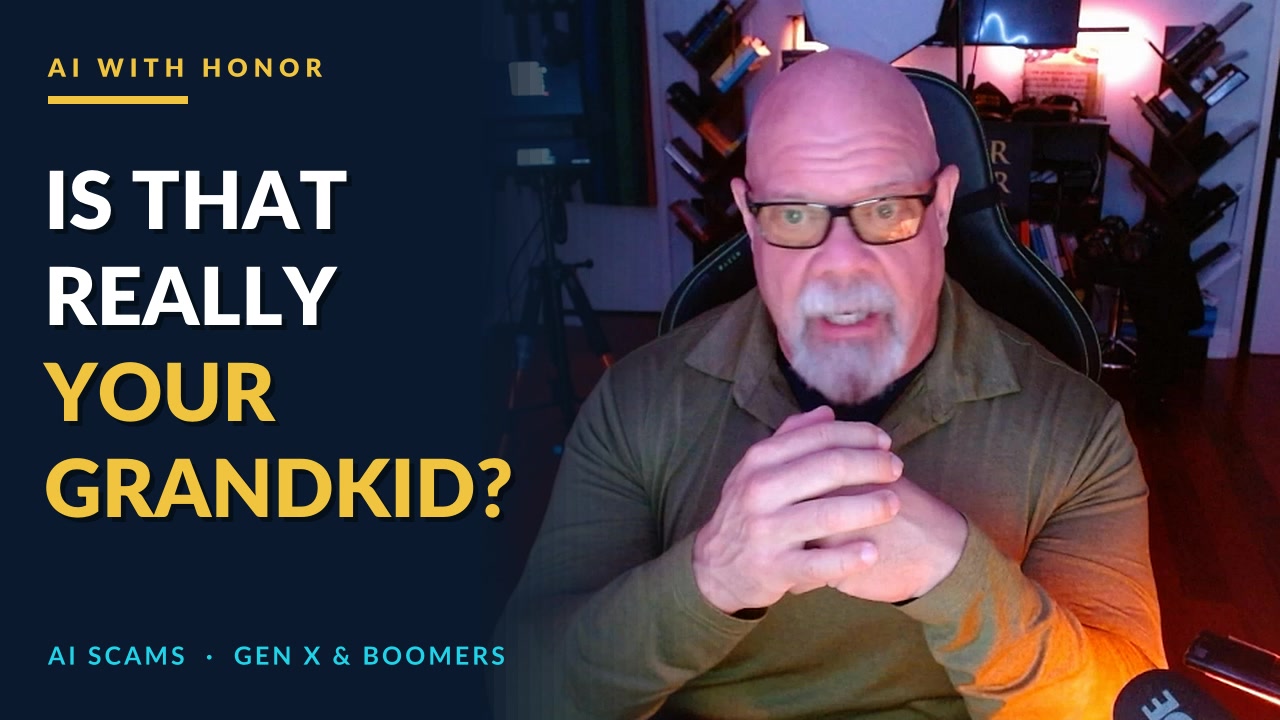
The Anchor
This one is for us. Gen X and the Boomers. I've never met a Boomer I didn't like, and I'm Gen X myself, born in '69. We grew up with rotary phones and Montgomery Ward. Now we're living through the biggest change in technology any of us will ever see, and a lot of it is being explained to us by people half our age who are trying to sell us something.
I'm not that 19-year-old. I sell houses. I build AI tools. But that's not why I did this show. I spent 20 years with LAPD. A lot of that time I was teaching: cadets in the academy, firearms, DUI, radar and laser, traffic safety for the community. Teaching people how to stay safe is in my blood. And right now the thing that worries me most for our generation is simple. It's getting hard to tell what's real from what isn't. AI is going to fool everybody. Not just us. Everybody. So let's get ahead of it.
Is that really your grandkid on the phone?
Maybe not. Here's how the call goes. Your phone rings. It's your grandkid, or your son, or your daughter. They're upset. "Grandpa, I need this. I need it quick. Something bad happened." The voice is right. The way they talk is right. Maybe it's even a video call and the face is right too.
And you believe it, because why wouldn't you? You'd do anything for that kid. So you head to Walmart to wire money through Western Union. Or you Zelle it. Or you Venmo it. Gone.
Here's the question I want you to ask before you send a dime. How do you know that was the person? A few years ago the answer was easy. You knew their voice. Today AI can copy a voice from a short clip. A few months ago you might have caught it. With the newest tools, in most cases, you can't tell. That's the whole problem. It looks the same, talks the same, acts the same. It's not them.
I wrote about the family safe phrase before, back in the family safe phrase that beats a voice clone scam and again in the deepfake safe phrase. This show goes deeper on the part most people get wrong: how you set it up and how you keep it working.
Why do AI scams work so well on our generation?
Because they use the people we love against us. Think about who you would drop everything for. Not the folks who always have their hand out. The ones who actually need you. Those are exactly the people a scammer will pretend to be, because those are the people who move your money.
And they will come. They'll come for you, and they'll come for everyone. This is just starting. Just when you thought you were going to get to relax, there's no relaxing on this one. That doesn't mean panic. Don't freak out. It means pay attention.
Here's what most people miss. The voice isn't the weapon. Time is the weapon. These scams work off of time. They need you to act before you think. "Right now." "Before it's too late." "Don't tell Mom." Every one of those lines is built to rush you.
And the older I get, the faster time goes. You know exactly what I mean. When we were kids we had all the time in the world. Now it flies. Scammers know our mindset. They know we're trying to get things done, we're worried about time, and we'll move fast for family. So they lean on that. The fix starts with one habit: don't knee-jerk. Slow down. A real emergency survives a five-minute check. A scam doesn't.
- It's urgent and it's about money, right now.
- They want a hard-to-reverse payment: wire, gift cards, Zelle, Venmo, cash pickup.
- They ask you to keep it secret from the rest of the family.
- The story keeps changing, or they won't answer a simple personal question.
- They get pushy when you say, "Let me call you right back."
What is a family safe phrase?
It's a short phrase only your family knows, used to prove a caller is really who they say they are. When someone calls in trouble and asks for money, the first part of that conversation has to be the phrase. No phrase, no money. Period.
On the LIVE I gave an example. Your grandkid calls: "Grandpa, it's me. John has a long mustache. I need you to send me 50 bucks." John has a long mustache. That's the phrase. Got it. Now you know it's them.
Don't use mine. Everybody who watched that show now knows it. That's the point of an example. Make your own.
How do you make a safe phrase that actually works?
This is where most families slip. A safe phrase is only as safe as the way you create it, share it and keep it. Here's how I'd do it.
Step 1: Make it something nobody could guess
Not your dog's name. Not your street. Not your anniversary. Not anything on your Facebook. Scammers read your posts. Pick something odd, something most people would never see or say, but something you'll remember. On the show I said it's got to be more than "chivalry" and more than "naked mole rats." Something a little strange works better than something obvious.
Step 2: Make sure you can recall it under stress
When the call comes, your heart rate is up. That's when people forget things. So the phrase has to be easy enough to pull out of your memory when you're scared. Short. Vivid. A picture in your head, like a guy with a long mustache. If you have to look it up, it's too complicated.
Step 3: Never share it over the phone, text or email
This part matters more than anything else. If you set up your safe phrase in a text message or a phone call, assume somebody else can get it. Do it in person. Make them get off the couch and come visit you. If you can't see each other, put it in a handwritten letter. Then shred the letter once it's memorized. Don't read it out loud in front of the TV or a smart speaker. I'm half kidding about the cameras. Only half.
Step 4: Change it after every use
Once a phrase has been said on a phone call, it's been exposed. Somebody could have been listening. So after it's used once, you make a new one. You can't live with the same phrase forever. Treat it like a key you replace after somebody borrows it.
Step 5: Set it up both ways
The roles can be reversed. A scammer might call your kids pretending to be you. "It's Dad. I'm in the hospital. Send money." So your family needs a way to check you, too. Same rules. And if you think nobody loves you enough to get scammed over you? Don't you worry. When the scammers call, you'll find out a lot of people care about you. At least for that moment.
- Pick something odd that isn't on social media and nobody could guess.
- Keep it short and vivid so you can recall it when you're scared.
- Share it in person or by handwritten letter. Never by phone, text or email.
- Shred the letter once it's memorized.
- Require it before any money moves on an emergency call.
- Change it every time it's used.
- Set one up both ways, so your family can check you, too.
What should you do if the call comes and they don't know the phrase?
Hang up. Then call the person back yourself, on the number you already have for them. Not the number that just called you. If you can't reach them, call another family member who would know where they are. Don't send money while you're still on the first call. Don't let anybody keep you on the line. Time is their weapon, so take it away from them.
If you already sent money, don't sit on it out of embarrassment. Call your bank or the payment app right away and report it. The faster you move, the better your chances. And tell your family. The shame is what keeps these scams quiet, and quiet is what lets them keep working.
The Machine
Why is "artificial" the wrong word for AI?
Because our generation knows exactly what artificial means. Artificial anything is never as good as the original. Artificial sweetener. Artificial grass. Artificial flavor. It doesn't taste right. It doesn't feel right. So when somebody says "artificial intelligence," part of our brain hears "fake," and we tune out.
That's a mistake, because this isn't fake. It's a real form of intelligence. I'd call it synthetic intelligence. Or human-created intelligence. That's why I named my own AI assistant Si. Call it what you want, but don't let the word fool you into thinking it's a toy.
Why does intelligence change everything?
Intelligence was the game changer of all time. The smartest people tend to cause the biggest problems, or save the most people. That sword cuts both ways. And now we've built intelligence into machines.
Here's the way I explained it on the LIVE. AI isn't the hammer. It isn't the warhead. It's the hand that drives the hammer. It's what turns a tool into something that can decide.
And there's one part that should get your attention. You and I, sitting on a park bench feeding pigeons, can tell each other stories all afternoon. I can tell you about the day my police motorcycle went down in 1994 and I should have died. You'll get some of it. You'll never get all of it, because language can't carry every nuance of what I lived through. AI systems are different. When one learns something, others can get all of it, block, stock and barrel. That's a whole different kind of learning, and it's why this is moving so fast.
Is AI a kid's game?
Right now, yes. My estimate on the show was that maybe 14 or 15 percent of Americans really use AI, and probably fewer in our generation. That's my read, not a study. The people building it are young and very, very smart. I give them all the credit in the world.
But it shouldn't be run only by them. Some things only come with age. Point of reference. Patience. The ability to slow down and ask, "What could go wrong here?" Our generation can be hellacious advisors. So once in a while, somebody building this stuff should ask the old guy what he thinks. He might just tell you. I made the same case about the human side of this shift in the Transition Moonshot: AI from the ground floor.
Are companies really cutting jobs because of AI?
Sometimes. But my take is that a lot of the time, AI is the excuse. A lot of companies over-hired during COVID. Now they want to cut back. Saying "we replaced them with AI" sounds forward-thinking, and Wall Street tends to like it.
Here's what nobody does. Nobody sits down with the list of 33,000 people and goes name by name. "Letitia. Was she replaced by AI? What does the AI do now that she did?" Nobody checks. They say it, and they get the credit. There's no validation, at least not yet from what I can see. That's my opinion, and I think somebody should start asking for the receipts. I dug into who really makes that call in the machine didn't sign the layoff.
Is AI really solving math?
Some of the labs say so. In September 2026, OpenAI claimed a proof on one of the famous unsolved problems in mathematics, the Navier-Stokes equations. That's a claim. It's still under independent review, and I can't check the math myself. If you ask the ex-LAPD motor cop to explain Navier-Stokes, you're getting shock and awe, not wonder and awe.
What I can tell you is the human side. There are mathematicians who gave their careers to problems like that. If a machine gets there first, what happens to them? Look at radiology. People predicted AI would wipe out the doctors who read scans. Instead, more scans got done and more readers were needed. Maybe math goes the same way. New math means new materials, new designs, new jobs. Maybe. I wrote about that pattern in the AI access gap, explained simply.
How does Connor use AI every day?
All day. I use it to prepare shows like this one, to keep up with the news and figure out what it means for people on the ground floor, and in my real estate work. I don't even need the most advanced model for most of it. What I'm doing is useful, not science fiction. I'm not inventing drugs or solving physics. I'm getting good information to the people who need it, faster.
And that's my point for our generation. You don't need to become an engineer. You need to know enough to stay safe, and enough to put it to work where it actually helps. If you run a small business and want to see what that looks like in practice, read stop losing service leads after voicemail.
Bring It To Your Group
Can Connor come talk to our community?
Yes. That's why I did this show. If you live in Santa Clarita, the San Fernando Valley, Palmdale or the Antelope Valley, and you've got a rec room, a clubhouse or a group of folks who want to hear this, I'll come to you. We'll talk about how these scams work, how to set up your safe phrase, and what AI means for people like us. No sales pitch. Bring your questions.
Learning this stuff is good for you, too. It gets the brain working in new ways. It helps me, and I think it'll help you.
Video chapters
- 0:00 Gen X, Boomers and the human part
- 1:19 Why I teach this
- 2:39 Why "artificial" is the wrong name
- 3:45 Intelligence is the game changer
- 5:27 The day I should have died
- 7:13 AI shares everything it learns
- 7:43 Will one super intelligence win?
- 8:47 Moonshots and "a little rough"
- 10:18 Pensions and the AI money
- 11:20 Anthropic, OpenAI and who uses AI
- 11:56 A kid's game that still needs us
- 12:36 Navier-Stokes and the math solves
- 16:32 Radiologists and the jobs question
- 17:34 Are layoffs really about AI?
- 18:37 How I use AI every day
- 21:21 Keeping you safe from AI scams
- 22:43 The fake grandkid call
- 24:14 Make a safe phrase
- 26:59 Book a talk for your community
Want me to bring this talk to your community, rec room or group? We'll cover AI voice scams, the family safe phrase, and what AI means for our generation. Text AI to (661) 476-2217.
Make the phrase. Share it in person. Change it after every use. And when somebody's rushing you, slow down. That's AI With Honor. Be well. Over and out.
The Daily Download In Your Inbox
Weekday takes on AI, real estate, and reading the world like someone who used to work it. No spam. Unsubscribe anytime.
Common Questions
Can AI fake my grandkid's voice on the phone?
Yes. AI tools can copy a person's voice from a short recording, and newer tools can fake video calls too. Connor MacIvor's point is that you can no longer trust a familiar voice alone when someone calls in trouble asking for money.
What is a family safe phrase?
A short phrase only your family knows, required at the start of any emergency call that asks for money. If the caller can't say it, no money moves. Connor recommends picking something odd that is not on social media and is easy to recall under stress.
How should a family share its safe phrase?
In person, or by handwritten letter that is shredded once memorized. Never by phone, text or email. Connor also says to change the phrase after every use and to set one up both ways, so the family can verify you too.
Why do AI scams rush you?
Because time is the scammer's weapon. Urgency keeps you from checking. Connor's rule is don't knee-jerk: hang up, call the person back on the number you already have, and never send money while still on the first call.
Can Connor MacIvor speak to our community group?
Yes. Connor offers AI scam-safety talks for communities, rec rooms and groups in Santa Clarita, the San Fernando Valley, Palmdale and the Antelope Valley. Book at bookwithhonor.com or text AI to (661) 476-2217.
Connor T. MacIvor · CalDRE #01238257 · Sync Brokerage, Inc. · DRE #02031490