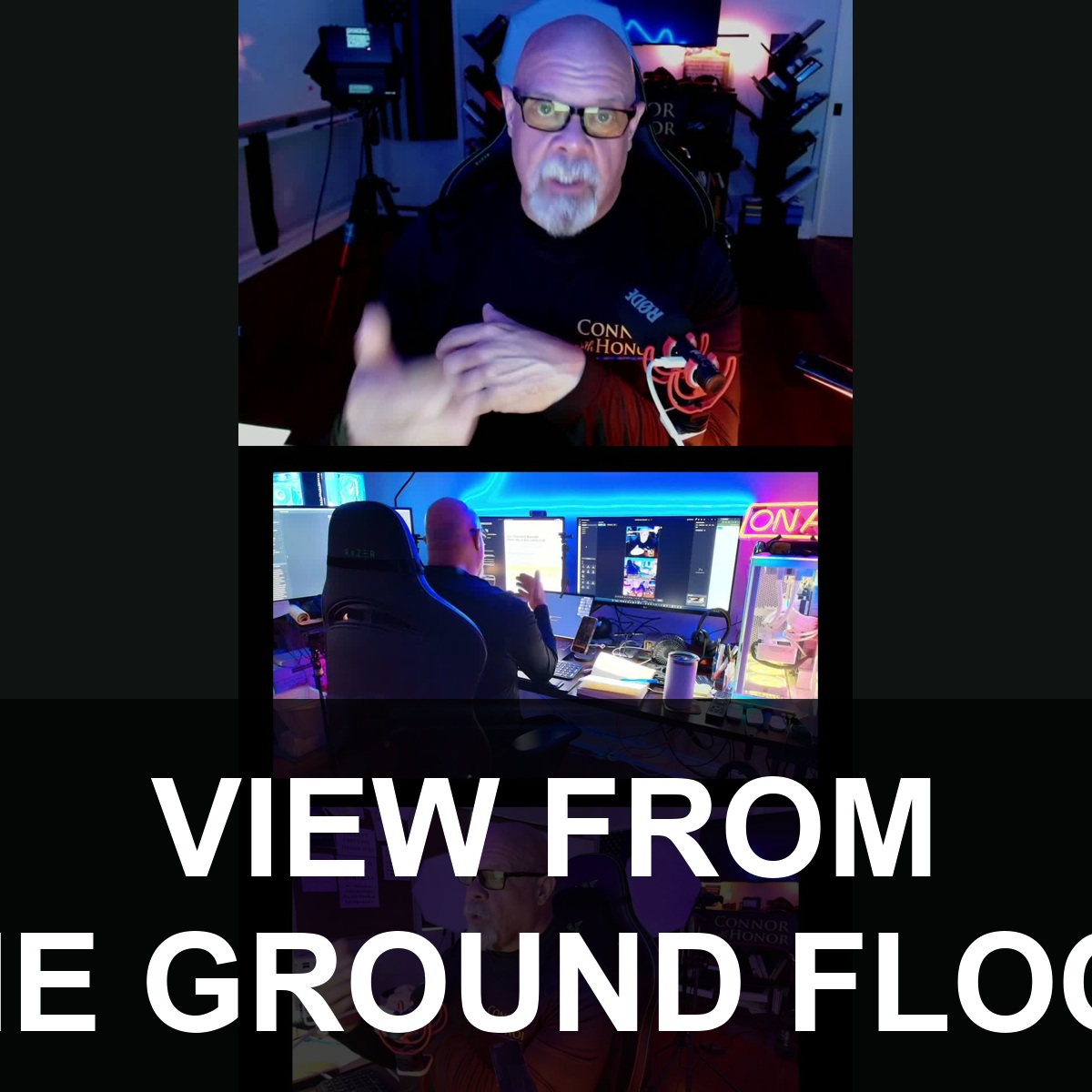
A three-day workweek sounds beautiful from the top floor. Connor MacIvor asks what happens to the people on the ground while the transition is still happening.
Jeff Bezos can look at artificial intelligence and imagine a future where some people work three days a week. From the ground floor, Connor MacIvor hears the same sentence and asks the missing question: for who? That question is not cynicism. It is the basic quality-control step that should happen before any billionaire forecast becomes a public mood.
The promise sounds beautiful when it floats above the people who absorb the transition. Fewer hours. More productivity. A household that does not need two earners. More abundance. More flexibility. More time. Nobody should be against that destination. The issue is whether the people on the ground actually receive the bridge, or whether they are told to admire the destination after the floor under them has already moved.
Fortune reported on October 9, 2026 that Bezos told Fox News some people may be able to support a family on a three-day week, and that households may not need two earners in the same way. The same Fortune piece also noted that Amazon has cut about 30,000 corporate roles since late last year, which is exactly the tension Connor stopped on during the live show. Fortune covered the Bezos comments and the Amazon cuts here.
That is why Connor's line lands: says who? If thirty thousand corporate roles disappear, some of those people did not get a three-day week. They got a zero-day week. That does not make the long-term productivity argument false. It makes the timing and ownership question unavoidable. A future abundance story that cannot explain the present transition is not a plan yet. It is a forecast with other people's lives attached. For the earlier version of this operating frame, read The Machine Didn't Sign The Layoff.
The Ground Floor Test
The ground floor test is simple. When a powerful person describes the benefits of AI, ask who gets the benefit first, who takes the risk first, and who has enough savings or ownership to survive the gap. If the answer is mostly investors, founders, platform owners, and executives, then the story is not about the whole economy yet. It is about the top floor talking about what the elevator may do later.
Connor's series keeps returning to that image because it is the cleanest way to describe the AI transition. People at the top can talk about abundance as an approaching weather pattern. People on the ground have to decide what to do with the rent, the mortgage, the payroll, the client file, the listing appointment, the kid's tuition, the business lease, or the job that might be rewritten before the benefits arrive.
A three-day week would be wonderful if the pay stayed livable, the work stayed meaningful, and the extra time belonged to the worker. It is a very different thing if the three-day promise arrives as a five-day job becoming a three-person workload, or as a department reduction that leaves the remaining team carrying more work with an AI tool and less support. The calendar alone does not tell the story.
That is why this episode is not anti-AI. Connor is not arguing for people to ignore the tools or pretend the technology is not real. He is arguing for accountability in the transition. AI can be useful, powerful, and worth building with. It can also become a public relations blanket over decisions that were made by humans with budgets, incentives, and authority.
The Data Is Already More Complicated Than The Slogan
Workday's October 2026 Global Workforce Report is useful because it does not reduce the moment to a single headline. Workday said 40% of business leaders expect AI to increase productivity from existing employees, while 28% expect it to reduce headcount. That is not a clean story of mass elimination, and it is not a clean story of painless abundance either. Workday released the report summary on October 5, 2026.
The same report shows a sharper skills shift underneath the surface. Demand for basic AI skills, including simple prompting, peaked in January 2026 and then fell 25%. Demand for hands-on skills such as building AI tools, automating workflows, and AI engineering rose 51% between September 2025 and July 2026. That is the market telling people that using the tool casually is not enough for long.
Connor's practical point lives right there. If the economy is moving from basic prompting to building and automation, the person who only waits for the future to become fair is in a dangerous position. The person who learns how to use the tools on real work has a better chance. But the fact that workers need to adapt does not excuse leaders from designing a transition that does not treat people as disposable packing material.
The workforce data also explains why the three-day-week promise can feel insulting from the ground. Workers are being told to become more adaptable at the same time internal mobility is tighter, promotions are not the easy escape hatch, and restructuring keeps touching more teams. That does not mean everyone is doomed. It means the bridge has to be real enough for ordinary people to stand on.
Stan Is The Transition In One Person
Connor's Stan example is the cleanest version of the moral math. Imagine a business with a human worker named Stan. AI comes in and creates the equivalent of two more shifts. The cheap answer is to say the machine now does the work, so Stan can go. The better answer is to ask whether the new capacity can help the business keep paying Stan and bring in another person too.
That is not charity language. It is business design language. If AI creates more productive capacity, then the first design question should not be only how to remove labor cost. It should be how to use the new capacity to make the business more survivable, more useful, and more humanly durable. Connor is not saying every company can keep every role unchanged. He is saying the default should not be extraction disguised as progress.
The Stan example also corrects a lazy debate. Too many conversations frame the future as either anti-AI resistance or blind acceleration. Connor is choosing a third lane. Use the tool. Build with it. Increase the output. Then have enough imagination to share some of the upside with the people whose work made the business possible in the first place.
That is where the Transition Moonshot comes in. The moonshot is not a slogan about keeping everything the same. It is a challenge to measure whether the transition actually improves capability for workers, small businesses, and local operators. If AI saves time, where does the time go? If AI creates new capacity, who owns the capacity? If AI lowers cost, who sees the benefit besides the margin line? The deeper companion piece is The Transition Moonshot: AI From The Ground Floor.
Those are measurable questions. They are not sentimental questions. A business can track training, new workflows, saved hours, redeployed work, retained people, new services, client outcomes, and added revenue. If leaders want to claim the transition is good for people, they should be able to show where the good landed.
Do Not Hate The Tool
One of Connor's strongest cautions is also one of his most balanced. Do not hate AI. Do not hate superintelligence. Hating the tool is too easy, and it lets the actual decision-makers disappear from the frame. The people who choose layoffs, compensation, internal training, customer policies, pricing, hiring freezes, and automation rollouts are still people.
That matters because a machine does not sign the layoff. A model does not decide whether the savings go to workers, customers, or shareholders. A chatbot does not choose whether a support team is trained into a higher-value role or quietly pushed out. A board, an executive team, an owner, a manager, or an operator makes those choices.
AI can become the excuse when the human decision is uncomfortable to defend. That is why the ground-floor frame is useful. It keeps the person with authority in view. If a company says the technology made them do it, ask who bought the technology, who set the metric, who approved the rollout, and who decided what would happen to the people on the other side.
That is also why the solution has to include ownership and skill, not just protest. A worker who can build automations, check outputs, repair workflows, and understand the system has more leverage than a worker who only knows that the system feels unfair. A small business owner who can use AI to serve clients better has more options than one waiting for a platform to treat them gently.
Somebody Else Will
Connor also names the pressure that executives feel: if one company does not use the capability, somebody else will. That pressure is real. Markets punish hesitation when a competitor finds a cheaper or faster way to deliver the same thing. The fear is not invented. A company that refuses to adapt can lose the business, which can hurt workers too.
But the existence of pressure does not settle the ethics of the response. A business can adapt with training, redeployment, shared upside, new service lines, and careful sequencing. A business can also adapt by cutting first and explaining later. Both paths may use AI. Only one path treats people as part of the transition instead of debris from it.
The phrase somebody else will should begin a design conversation, not end it. If the tool is coming, what is the most responsible way to absorb it? What should be automated first? What should remain human-facing? Which jobs become more valuable when AI handles the repetitive layer? Which people need training before the system changes? What does success look like beyond a smaller payroll?
Those questions are not slow. They are disciplined. The fastest move can become expensive if it damages trust, loses institutional knowledge, creates rework, or leaves customers stuck in a brittle automated process. The cheap-looking path often hides its cost in places the spreadsheet does not respect until later.
Chess, Go, And Human-To-Human Value
Connor's chess and Go point helps separate capability from meaning. AI can beat humans at games that once looked like monuments to human strategy. People still play each other. They still watch people play. They still care who made the move, how pressure changed the game, and what a person saw in the moment. Human-to-human value did not vanish because the machine became stronger.
That does not mean every job is safe because humans like humans. It means the value question is more specific than raw capability. In some areas, people will happily choose the machine because the outcome is cheaper, faster, or better. In other areas, the human relationship is part of the product. Real estate, advising, negotiation, coaching, leadership, trust-building, and accountability do not reduce neatly to a benchmark score.
For agents and service providers, this is the part worth taking seriously. If a machine can generate generic advice, the human has to become more specific, more accountable, and more useful. The answer is not to pretend generic advice remains scarce. The answer is to bring judgment, local context, personal responsibility, and proof of care into the work the machine cannot own.
That is why Connor's content keeps pointing back to real workflow. The person who can combine AI with a trustworthy service layer becomes harder to replace. The person whose value was only forwarding information becomes easier to compress. The future is not evenly distributed because usefulness is not evenly distributed.
The Real Estate Side: Assumable Loans And The Gap
The live show also touched real estate because the ground-floor frame applies there too. Assumable FHA and VA loans can matter in a market where old financing terms look very different from current options. But Connor's caution is important: the buyer still has to solve the gap between the remaining loan and today's purchase price.
For VA loans, assumptions can involve additional rules, approvals, and circumstances that are not captured by a casual social post. A non-veteran may be able to assume in some situations with approval, but that does not make the transaction simple or universally available. A seller and buyer still need clear advice from the right professionals before treating it as a magic affordability answer.
That is the same pattern as the AI story. The exciting headline is only the start. The ground-floor work is in the details. What does this actually mean for this person, this deal, this business, this job, this cash position, this deadline, and this risk? The useful professional does not stop at the headline. The useful professional explains the gap.
What The Three-Day Week Would Need To Be Real
A real three-day-week future would need more than productivity. It would need a fair way to distribute the gains, a retraining path that arrives before displacement, and enough new business formation for people to create value outside old job boxes. It would need health coverage, debt pressure, housing costs, family needs, and local economies to be part of the conversation. That is the same gap Connor mapped in AI Won, But Who Pays The Gap?.
It would also need leaders who are willing to say exactly what happens during the middle years. The middle is the part everybody wants to skip. That is where a worker is too experienced to start over casually, too young to be done needing income, and too exposed to wait for abundance to become local. The middle is where the transition is either humane or not.
Connor's answer is not to freeze the world. It is to build the bridge on purpose. Teach people the applied skills. Use AI to expand output without automatically discarding the people. Create new service lines. Let small businesses access the tools instead of leaving them only for giants. Track whether the promised gains show up outside the top floor.
That is what makes the Transition Moonshot a better conversation than a vague promise. It asks for evidence. Did the worker become more capable? Did the business become more resilient? Did the customer get better service? Did the owner create new opportunity instead of only cutting cost? Did the local operator gain leverage against the platform, or did the platform gain more control over the operator?
What To Do From The Ground Floor
If you are on the ground floor, the first move is not panic. The first move is inventory. What part of your work is repetitive? What part requires judgment? What part depends on trust? What part could be automated by someone else if you do not understand it? What part becomes more valuable if you can build with AI instead of only use it?
Then pick one practical workflow. Do not begin with a grand identity crisis. Begin with the task you repeat every week. Drafting a follow-up. Comparing documents. Building a client checklist. Turning a long explanation into a short one. Creating a post schedule. Checking captions against a hold list. Summarizing a showing note. The person who learns on real work gains more than the person who collects abstract AI opinions.
The same advice applies to a team lead who is trying to keep people useful. Pick one workflow where the tool can remove friction without removing the human owner. Let the person who already understands the customer help shape the automation. Make the output visible. Review the mistakes. Keep the record of what improved, what broke, and what still needs judgment.
That kind of implementation is slower than a glossy demo and faster than cleaning up a careless rollout. It gives the business a way to learn with the people who know the work. It also gives the worker evidence that adaptation is not just a slogan being used against them. Evidence matters when trust is thin, especially when the next reorganization may arrive before the last promise has been tested in public yet.
For business owners, the same rule applies with a larger responsibility. Before you use AI to remove a person, test whether the same system could help that person produce more valuable work. Before you call a role obsolete, ask whether the role can be redesigned around judgment, client care, quality control, or new delivery. The savings may still be real, but the first question should not be how quickly a human can disappear.
For policymakers and community leaders, the question is whether local people can access useful tools, training, and ownership. A future where only large companies can build with AI is not the same future as one where small operators can use local systems, owned workflows, and practical automation to compete. The ground floor needs tools it can actually hold.
The Accountability Layer
The strongest part of Connor's close is the accountability layer. He is looking up from the ground floor and saying trust still matters. Accountability still matters. The open question is how long it takes for AI systems to provide their own level of trust, and who is responsible while they do not.
That question should follow every AI promise. If the system gives wrong advice, who answers? If the automation hurts a customer, who fixes it? If a worker is moved out because a model looked good in a demo and weak in production, who owns the damage? If the productivity gains are real, who decides where they go? Trust is not a marketing adjective. It is the chain of responsibility after something important happens.
A three-day workweek can be a worthy future. A single-income household can be a worthy hope. Better tools, better productivity, and less drudgery can all be worth building toward. But the ground floor deserves more than a beautiful forecast. It deserves a transition plan with names, receipts, training, ownership, and measurable upside.
So the answer to the headline is still the same: for who? If the answer becomes workers, families, small businesses, clients, and communities, then the promise starts to become real. If the answer stays mostly the people who already own the elevator, then it is not a three-day workweek yet. It is a zero-day warning dressed as abundance.
Connor's position is clear. Build with AI. Learn the tools. Do not hate the machine. Do not let powerful people hide behind it either. The future may be abundant, but the bridge has to be built from the ground floor up.