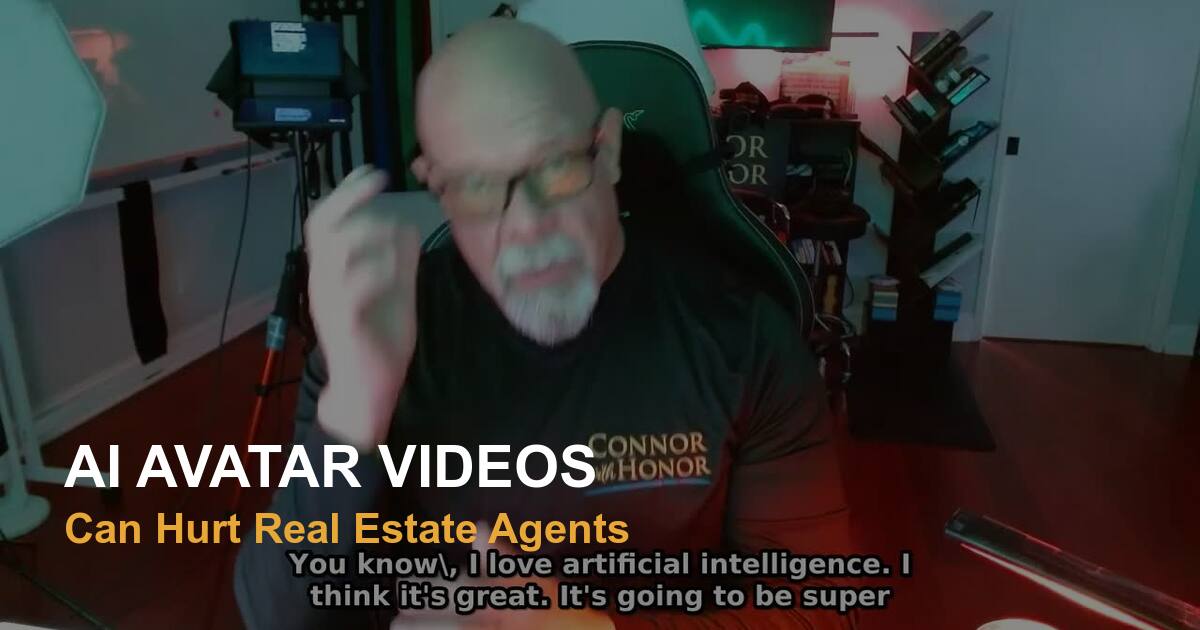
AI can help a real estate agent finish the work. It should not become the face that replaces the agent's proof of care.
AI is a hammer. That is the cleanest way to hear Connor MacIvor's point in this video. A hammer can build something useful, or it can dent the table because the person holding it wanted a shortcut. Artificial intelligence is not the problem by itself. The problem is what a service provider decides to hand over to the tool.
For real estate agents, avatar video looks tempting because it solves the painful part. You do not have to sit down. You do not have to look into the camera. You do not have to stumble through a thought, fix the opening, or build the habit. You can give the system a prompt, let it create a face, let it read the words, and let the machine package the result. That sounds efficient. It can also make the agent look like the one person who could not be bothered to show up.
That is the center of this episode. Connor is not anti-AI. He uses AI every day. He builds with it, edits with it, checks work with it, and pushes it into real business systems. The warning is narrower and more useful than a blanket rejection. If your business depends on personal trust, and real estate absolutely does, do not let AI become your public face before the public has a reason to trust you.
A homeowner does not hire a listing agent because the agent can recite a generic script. A homeowner hires someone to protect the result of a high-stakes transaction. Price, timing, disclosure, negotiation, presentation, offer quality, inspection response, escrow pressure, and closing risk all land on a person. If the first visible proof of that person is an avatar reading a script, the message can be: I want the authority of advice without the burden of being present.
That may sound harsh until you flip the roles. If a homeowner asked an agent to sign a listing agreement with an avatar, the agent would not treat it as normal commitment. The agent would want the real owner, real signature, real voice, and real authority. The same instinct applies in reverse. Clients want to know whether the person representing them is actually there.
Why Avatar Video Feels Different From Editing
There is a big difference between using AI to finish a video and using AI to replace the human in the video. Finishing is the part after the agent has already shown up. The agent records the thought. The agent explains the point. The agent carries the judgment. AI can clean the transcript, cut dead space, create captions, resize the frame, make a title list, draft a companion article, or check whether the upload hit the right account.
That is a good hammer. It saves production time without pretending to be the professional. The agent is still the one making the claim. The agent is still accountable for the advice. The agent is still visible enough for the viewer to judge tone, confidence, hesitation, limits, and care.
Avatar replacement is different. It moves the human out of the evidence layer. The agent may have approved the script, but the viewer is no longer watching the agent handle the thought. They are watching a synthetic stand-in. That matters because service businesses sell confidence before they sell process. If the confidence is synthetic, the process now has a trust problem before it even starts.
For a useful companion frame, read An AI Idea Is A Starting Point. Your Business Playbook Is The Difference. That article makes the same operating point from another angle: AI can draft, organize, and accelerate, but the business still needs the rules, examples, corrections, and judgment that make the work safe.
The Lazy Signal
Connor uses the word lazy because it is the signal a viewer may receive, even when the agent feels busy. The agent may think, I am saving time. The viewer may think, this person did not have time for me. Those are different stories. The viewer's story is the one that matters in public content.
A real estate agent can be busy in a good way. Busy can mean active clients, active showings, active negotiation, market study, inspection review, and problem solving. But when the public face becomes synthetic, the busyness does not look like competence. It can look like absence. In a relationship business, absence is expensive.
The lazy signal is not only about the face. It is about the missing effort. The viewer cannot see the agent wrestling with a real example. The viewer cannot see the agent choose a careful word. The viewer cannot see the agent correct a thought, admit a limit, or explain why one client situation is not the same as another. All of those small human moments create trust. Avatar video sands them down.
That does not mean every rough human video is good. A rambling, careless, unverified video can still hurt the agent. The answer is not to celebrate sloppy content. The answer is to keep the human at the center and use AI around the edges, where the machine improves the delivery without stealing the proof of presence.
Real Estate Is Not A Dancing Cat Business
Connor draws a line between attention content and service-provider content. If someone is trying to make a fictional character, a joke account, a novelty channel, or a pure entertainment feed, synthetic video may fit the point. The audience is there for the device. They know the format is manufactured. The performance is the product.
A real estate agent is in a different lane. The audience is not only asking, was that entertaining? They are asking, would I trust this person with a house, a timeline, a negotiation, or a disclosure question? That is why the same tool can be harmless in one setting and damaging in another.
The homeowner does not need the agent to become a celebrity. The homeowner needs the agent to be useful, reachable, and visibly responsible. The best agent content often feels more like a field note than a performance. What did you see this week? What question keeps coming up? What mistake are sellers making? What does this market condition change? What should a homeowner do before signing anything?
Those answers do not require a synthetic face. They require a real agent willing to explain the work. That is also why Connor's real-estate operating lane stays seller-focused. When he talks about representation, the central promise is protection and clarity for the seller, with buyer needs routed carefully through appropriate buyer-only specialists when needed. The public content has to match that responsibility.
Clients Are Not Buying A Script
The problem with avatar video is not that the words are automatically wrong. AI can write useful words. It can also write vague words that sound competent until a real transaction applies pressure. The deeper issue is that clients are not buying the script. They are buying the person who will stand behind the decision when the script runs out.
That shows up fast in real estate. A seller can ask whether to accept a clean offer below the top price. A buyer can ask whether a repair credit is enough. An escrow can hit a lender delay. A disclosure can trigger a follow-up question. A showing pattern can contradict the online praise. The value is not in having a paragraph ready. The value is in knowing what the paragraph means under pressure.
If an agent wants to use AI in that environment, the right question is: where does the machine improve preparation without hiding accountability? AI can turn a transcript into a checklist. It can compare a draft caption against compliance holds. It can find repeated phrases. It can produce short cuts from a longer explanation. It can create a first article outline. It can help a busy agent remember what to post next. None of that requires a fake version of the agent.
That is why Connor says finishing is fine. Finish the video. Finish the captions. Finish the edits. Finish the schedule. Finish the article. Finish the follow-up. Do not replace the one thing the viewer is actually trying to evaluate.
The Do List For Agents
Do record the real explanation first. It can be seated at a desk, standing with a phone, walking through a screen share, or talking after a showing. The production value can improve later. The first proof is that the agent can explain the issue in their own voice.
Do use AI to make the finished package easier to consume. A good production pass can remove dead air, fix caption timing, resize for vertical platforms, build a companion article, check for banned claims, and stagger the schedule so the same clip does not hit duplicate accounts at the same time. The viewer gets a cleaner asset, but the source remains human.
Do make one practical point per video. A real estate agent does not need to perform an entire seminar every time. One video can answer why avatar listing updates feel wrong. Another can explain what sellers should ask before accepting an offer. Another can show how monthly ownership costs differ from transaction costs. Another can point out how a small repair issue can become a negotiation problem.
Do keep the claim narrow. If you are giving an opinion, say it as an opinion. If you are talking about a current market fact, verify it. If you are explaining a law, source it and stay inside your role. If the video is about AI, do not use the word AI as a magic sticker over ordinary content. The useful part is the decision it improves.
Do keep a human route for the viewer. If the next step is a call, say that. If the next step is a seller conversation, say that. If the next step is an AI workflow discussion, send them to the matching lane. A confused CTA can waste the trust the video built.
The Don't List For Agents
Do not use an avatar to pretend you are doing the work yourself. The audience may not know the exact production method, but they can feel the gap. Once they sense distance, every later claim has to climb a hill.
Do not let AI write broad promises you would not defend in a listing appointment. Avoid claims that you are the best, biggest, fastest, or guaranteed to save someone money unless you have the evidence and the right legal footing. Real estate content is not a place for puffery that sounds harmless in a general marketing course.
Do not use generic luxury signals as a substitute for service. Fancy cars, jets, rented-looking success imagery, and synthetic polish can work against an agent whose job is to protect a client's interests. Most homeowners do not need a movie trailer. They need someone who knows what can go wrong and how to keep the transaction moving.
Do not assume that more automation equals more trust. Posting more can help only if the posts are useful, accurate, and tied to the right audience. A larger content machine can also spread weak claims faster. The hammer gets heavier. It still needs a hand that knows where to swing.
What This Means For Agent Pros
This video is also for the people selling tools to agents. If your product helps agents record, edit, caption, and distribute real explanations, you are helping. If your product encourages agents to skip the human layer entirely, you may be selling short-term volume at the cost of long-term credibility.
The better product promise is not: never appear on camera again. The better promise is: show up once, then let the system finish the work correctly. Turn one real explanation into a vertical clip, a long-form post, captions, an article, platform-specific copy, and a schedule that respects the account. That protects both efficiency and trust.
Agent pros should also separate internal automation from public representation. An AI intake tool can help route leads. A voice agent can help answer after hours. A workflow can remind a human to follow up. A content tool can prepare drafts. Those are operational supports. A synthetic avatar pretending to be the professional is a brand decision, not just a workflow decision.
That distinction connects to Connor's broader AI writing article, AI Writing Still Needs Your Voice And Your Judgment. Voice is not only word choice. It is ownership. It is the part that lets a viewer believe a real person is on the hook for what was said.
A Simple Content System That Keeps The Agent In The Game
The practical system is simple. First, record the real explanation. Second, transcribe it. Third, cut the strongest complete thought. Fourth, caption it carefully. Fifth, publish it with a title that says what decision the video improves. Sixth, write the companion article that turns the short thought into a useful answer. Seventh, track what actually went live and where.
That system sounds heavier than a one-click avatar until you remember what it earns. It earns proof. It earns a library. It earns source material that can be checked, reused, and improved. It earns a record of what the agent actually said. It also gives the agent more chances to notice weak thinking before the public sees it.
If the agent is worried about time, the answer is not to disappear. The answer is to lower the filming friction. Sit in the same chair. Use the same camera. Keep a running list of seller questions. Record one idea at a time. Let AI help with the dull parts after the human work is done.
This is exactly where AI belongs. Not as a mask. Not as a substitute identity. As a finishing bench. Use it to clean the package, check the hold list, schedule the post, build the article, and keep the agent's real judgment from dying in a folder.
The Trust Test
Before publishing an AI-assisted real estate video, ask one question: would this make a serious homeowner more confident that I will personally protect their interests? If the answer is yes, publish after the normal checks. If the answer is no, fix the asset or kill it.
That test catches a lot. It catches synthetic faces that look clever to the agent but distant to the client. It catches captions that overclaim. It catches vague AI advice that has no local use. It catches content that tries to be famous instead of helpful. It also catches the agent who wants the benefits of authority without the discomfort of showing up.
A service provider does not have to be perfect on camera. They have to be present, useful, and accountable. The human face is not vanity in that context. It is evidence. It tells the viewer that someone is there, someone thought about the issue, and someone can answer for the recommendation.
That is why Connor's final advice lands: use AI as the finisher, not the face. Let the hammer help. Do not ask the hammer to shake the client's hand.
What To Say Instead Of Making An Avatar
If an agent does not know what to record, start with the moments that already cost clients money or sleep. Explain what you wish sellers understood before pricing. Explain what happens when a buyer writes the highest number but carries weak terms. Explain why a clean disclosure package can reduce friction later. Explain what you check before recommending a repair, a credit, or a counteroffer. Those are not performance topics. They are service topics.
The best prompt is usually not a prompt to the machine. It is a real client question written at the top of a page. What should a seller do before the first weekend? What does a price reduction actually signal? What should a homeowner ask before signing a listing agreement? What is the difference between marketing activity and buyer confidence? Answer one of those in your own voice, then let AI help turn the answer into the right formats.
That approach also gives AI a better job. Instead of asking it to invent authority, you give it raw authority to organize. It can pull out the strongest hook, find the cleanest 30-second section, suggest a title, draft a checklist, and turn the explanation into an article. The machine is no longer pretending to be the expert. It is carrying the expert's work farther.
For agent teams, this matters even more. A team can set a simple rule: no public avatar claims as a substitute for the agent responsible for the client relationship. Use AI for operations, quality control, first drafts, caption repair, scheduling, and follow-up. Keep client-facing advice connected to a real human owner. The viewer should be able to tell who stands behind the recommendation.
The Business Case For Staying Visible
There is also a plain business case. Real video compounds. A library of real explanations trains the market to associate the agent with judgment. It gives future clients a way to sample how the agent thinks. It gives referral partners proof that the agent can explain hard topics without sounding canned. It gives the agent's own systems better source material for articles, emails, shorts, FAQs, and search pages.
Avatar video may create more assets faster, but if those assets do not build trust, they are empty inventory. A full shelf of weak proof is still weak proof. A smaller library of real explanations can outperform it because each piece carries the agent's presence, limits, and accountability. That is harder to fake, which is exactly why it is valuable.
This is not a purity test. Use the tools. Use the captions. Use the editor. Use the article draft. Use the scheduler. Use the internal assistant that reminds you which clip already posted and which account needs spacing. Just do not trade away the part of the content that makes the viewer believe a real person will answer the phone when the transaction gets hard.
Where To Go Next
If you are an agent, start with one real video this week. Pick a question you keep answering. Explain it in your own words. Then use AI to package the result. If the process helps you publish a clearer answer without hiding you, keep it. If the process creates a fake version of you that feels easier than showing up, stop.
If you are an agent pro, build tools that make the real agent easier to see. Help them finish. Help them schedule. Help them avoid compliance mistakes. Help them turn one explanation into useful assets. Do not sell them a shortcut that makes the public wonder whether they care enough to appear.
Connor's broader position is pro-tool and pro-accountability. AI can make the business sharper. It can also make weak behavior easier to scale. The difference is not the model. The difference is whether the person holding the hammer stays in the game.
For more on Connor's operating frame, read AI Can Help. You Still Need To Be In Control. Then come back to this episode and apply the same rule to real estate content: keep the tool, keep the proof, and keep the real person visible.