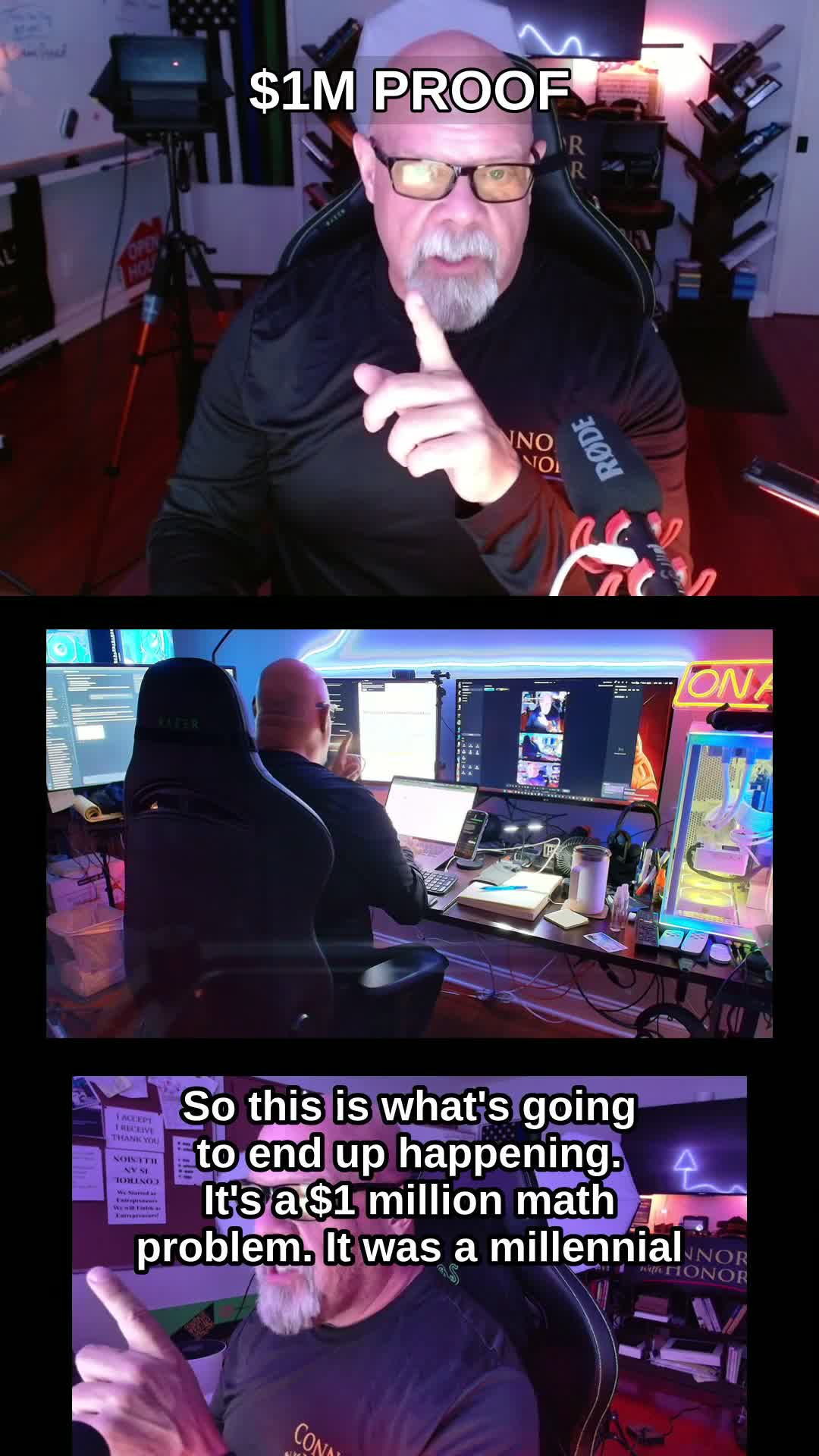
The viral version is simple: AI solved a $1M math problem and the mathematicians panicked. The useful version is sharper. AI did not make the prize disappear overnight. It exposed a review system that was built for human speed.
Connor's October 7 LIVE used Navier-Stokes as the spark, but the real subject was not one proof. The real subject was what happens when machines can produce work faster than the experts can verify it, when a regular chat product starts helping with open problems, and when every worker is told to train the thing that might replace the job.
That is a different kind of technology shock. It is not a new app with a cute button. It is a pressure test on every profession that depends on scarce review, credentialed judgment or slow expert consensus. Math is just the cleanest place to see it because the claim is either eventually correct or not. The messy part is everything that happens before that final answer.
The $1M Problem Was Not Awarded
The first guardrail matters. Connor talked about a Millennium Prize problem, Navier-Stokes, and the shock of a proof that humans still have to read carefully. That does not mean the Clay Mathematics Institute handed out a prize during the LIVE. It does not mean the world has already agreed the problem is settled. It means a serious AI-assisted result entered the room and forced experts to decide what careful review looks like now.
OpenAI announced the Navier-Stokes work on September 8, 2026. Reporting after that described a long proof, a major prize context and experts taking the result seriously while still needing time to inspect it. The right public sentence is not "AI won the prize." The right sentence is this: AI pushed a prize-level math claim into the expert review pipeline, and the pipeline was not ready for the volume that may follow.
That difference protects the viewer. It lets the clip be exciting without making a claim Connor cannot defend later. A public short can say the proof is difficult, the stakes are high and the review process is stressed. It should not say the prize was awarded unless the awarding body actually says so.
The Review Bottleneck Is the Story
Mathematics already had a trust system. Researchers write papers. Other researchers read them. Journals, preprints, conferences and informal expert networks decide what deserves attention. That system is slow because the work is hard. It is also slow because the people who can judge it are rare.
AI changes the speed of production first. A model can propose lemmas, search proof paths, translate structure, test variations and generate more candidate work than one person could produce alone. That does not make every output true. It makes the queue larger, faster and harder to triage.
That is why "it breaks our system" is such a strong phrase. The system was not built for a future where proof candidates can arrive in waves, where the author may be a team of models and humans, and where the limiting factor becomes expert attention rather than idea generation.
The same pattern appears outside math. A business can generate more ads than it can evaluate. A student can generate more essays than a teacher can grade. A company can generate more automation ideas than its managers can safely approve. The bottleneck moves from creation to judgment.
Meta Made the Point Even More Ordinary
The Meta detail matters because Connor framed it as a regular chat app, not a secret lab. Meta said Muse Spark inside the Meta AI experience helped close open problems across research papers. That is the part people should sit with. This is not only a story about elite labs running one dramatic experiment behind locked doors.
When the same class of tool shows up in ordinary chat, the boundary moves. A researcher, founder, analyst or student can ask for help at a level that used to require a bigger team. That creates opportunity. It also creates confusion because the interface feels casual while the implications are not casual at all.
A regular chat box can now participate in work that looks like research, product strategy, software architecture, hiring, legal analysis, medical triage, marketing or finance. The screen may look friendly. The output can still carry real consequences.
Same Fear, Different Loss
Connor connected mathematicians to customer service workers, drivers, office employees and anyone asked to train an AI assistant. The emotional shape is the same even when the job is different. A person spends years learning a skill. Then a system shows up and does part of the work faster, cheaper or at least confidently enough for management to ask questions.
The mathematician loses scarcity. The customer service worker loses the first layer of contact. The analyst loses the routine report. The scheduler loses the inbox. The real estate assistant loses the follow-up checklist. The fear is not identical, but the loss rhymes.
Connor's Stanley example is useful because it names the trap. Stanley is asked to train the assistant. At first it lowers his workload. Then the organization asks whether Stanley is still needed. That is not science fiction. It is the management question every AI rollout eventually creates if the owner has no rule for protecting human value.
The answer cannot be pretending the tools are useless. They are not useless. The answer also cannot be handing over the whole job and hoping loyalty wins. Loyalty is not a business model. The stronger answer is to move up the stack: own the workflow, own the judgment, own the customer relationship and own the accountability.
AI Interviews Cut Both Ways
The job interview segment raised a hard question. Would you rather be interviewed by a person or by AI? A person can judge you unfairly from a glance, a mood or a bias they never name. AI can judge you from far more data than you expected, including old public posts, patterns, tone, inconsistencies and whatever the employer connects to the system.
Neither option is automatically fair. The human may miss something important. The machine may see too much and understand too little. That is the central tension. A broader data net can reduce one kind of bias while creating another kind of surveillance.
A company using AI interviews should be able to answer basic questions. What data is used? What is ignored? Who can appeal the result? Which human owns the final decision? What is the system prohibited from considering? If those answers are vague, the interview is not more advanced. It is just more automated.
What AI Cannot Take
The cleanest line from the show came near the end: AI takes tasks. It does not take trust, judgment or accountability. That sentence should be the operating note for business owners watching this wave.
Tasks are the visible work. Send the reminder. Draft the email. Read the transcript. Summarize the call. Compare the listings. Build the first version. Check the calendar. Produce the social caption. A good AI system can do many of those things now.
Trust is different. Trust is why a client tells you the real constraint. Judgment is different. Judgment is why you know when the output sounds right but does not fit the situation. Accountability is different. Accountability is who answers when a decision hurts someone, costs money or exposes private information.
That is where the human owner has to stay visible. If a model drafts the answer, the human still owns the send. If a model summarizes the math, the expert still owns the review. If a model answers the phone, the business still owns the promise made to the caller. Automation does not erase responsibility. It concentrates it.
The Practical Move
Break your work into tasks before somebody else does it for you. Connor used an open house as an example: choose the date, create the marketing, place the signs, capture the visitor information, follow up, nurture, call, text, book, review and continue until the answer is clear. Once the workflow is visible, you can decide which parts AI should help with and which parts should stay human-led.
That exercise is not only defensive. It can also become a business. If you know a painful workflow at your company, you may be closer to a useful AI product than someone who only knows the tool. The person with domain pain has the better map. The AI can help build, but the person with the pain knows what finished should feel like.
The next step is not to panic. The next step is to inventory. Write down what you do every week. Mark what is repetitive, what requires private data, what affects money, what touches a customer, and what would embarrass you if it went wrong. Then decide where automation belongs.
That is how you stay useful in a world where AI can help with prize-level math and missed phone calls in the same week. You stop measuring yourself by the task. You measure yourself by the judgment around the task, the trust behind the task and the accountability after the task.
Where This Clip Belongs
This article is the slower half of the LIVE. The clips carry the moment: the $1M proof, the phrase about breaking the system, Meta's chat product, the AI interview question and the line about tasks versus trust. The article carries the limits.
Use the clip to start the conversation. Use the article to keep the conversation from outrunning the facts. AI may have changed the speed of math. It definitely changed the speed of work. The person who wins next is not the person who shouts the biggest prediction. It is the person who can verify, decide and stay responsible when the tool gets faster.
For more on keeping human control in the loop, read AI Can Help. You Still Need to Be in Control. For the business-discovery side, read Can AI Agents Find and Understand Your Business? For the workforce angle, read AI Replacement Has a Buyer Problem.